
Extreme Heat Action Plan Builder
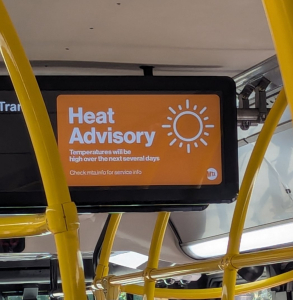
Heat Advisory Graphic in Public Transit
The Best Time to Build a Heat Plan Is When It’s Not Hot
The heat season is over for most of the country. That makes now the right time to plan for the next one. A heat action plan written in October is ready in May. One written in July is improvised.
Brizaga built a free tool that helps local governments do this. It is called the Extreme Heat Action Plan Builder, and it turns a menu of proven actions into a plan your departments can run.
Why plan for heat at all?
Heat kills more people than any other weather hazard. In 2024, National Weather Service records show 529 heat deaths in the United States, accounting for 49% of all weather-related deaths. Flash floods were next, at 119.
Heat is also becoming more common. The U.S. Environmental Protection Agency tracks heat waves in 50 large U.S. cities. Those cities went from about two heat waves a year in the 1960s to about six a year in the 2010s and 2020s. The heat wave season in those cities is now about 46 days longer than it was in the 1960s.
Yet heat is rarely the first hazard a community plans for. There is no landfall and no visible damage. The harm happens quietly, often indoors, and often to people who live alone.
What is extreme heat where you are?
There is no single temperature that counts as extreme. It depends on what people, buildings and infrastructure in a place are used to. A 95-degree afternoon is ordinary in South Florida. The same reading is an emergency in a city that rarely sees it, in housing built to hold heat in.
Humidity matters too. The heat index combines temperature and humidity into a “feels like” number. When the air is humid, sweat cannot evaporate, and the body cannot cool itself.
That is why a good plan starts from local triggers. The National Weather Service sets heat index thresholds for each area. It issues a Heat Advisory when conditions are dangerous for people who are vulnerable to heat. It issues an Extreme Heat Warning when conditions are dangerous for anyone without effective cooling. The plan builder uses your local NWS thresholds as the points where actions start, and you can adjust them.
What goes into a heat action plan?
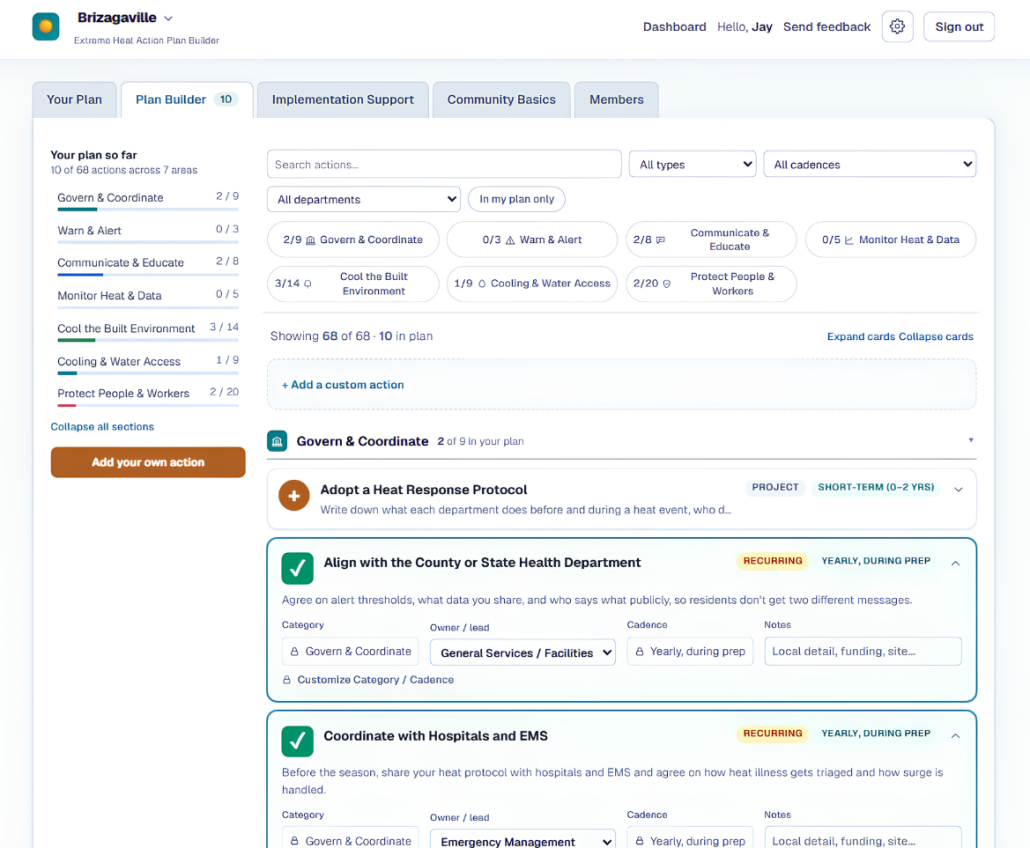
The tool’s action library is organized around the core elements in the World Health Organization’s Heat–Health Action Plans: Guidance. Most of the actions are adapted from the City of Miami’s Extreme Heat Plan, part of Miami Forever Climate Ready. Each one is rewritten in plain language and generalized so any jurisdiction can start from it.
Actions fall into seven categories:
- Govern and coordinate
- Warn and alert
- Communicate and educate
- Monitor heat and data
- Cool the built environment
- Cooling and water access
- Protect people and workers
Each action is also sorted by timing. Some are one-time projects. Others recur every year, every season, or every time a heat alert goes out.
A simple example: when a Heat Advisory is issued, a transit agency pushes the alert to its riders on buses and at stops. That reaches people who are already outside. In a plan, that action has an owner, a trigger and a place on the calendar before the first hot day.
What do you get from the tool?
You choose actions, assign an owner and timing to each, and the tool produces three things:
- A written plan of the actions you chose, grouped by function, with an owner, timing and description for each.
- A season calendar of recurring tasks and milestones. You can export it to Outlook or Google Calendar.
- A responsibility matrix that shows which department owns what.
The tool is free. There is no cost and no credit card, and the plan is yours to keep.
Who should build it?
A heat plan crosses departments. Emergency management usually issues the alerts. Parks and libraries often run the cooling centers. Public works and planning shape the built environment over the long term. Human resources is responsible for outdoor workers.
A good first step is to name one person to own the plan. That person then brings the departments together to choose and assign actions. The tool’s responsibility matrix is built for that meeting.
Start now
You can build your plan on your own, for free. If you would rather have a partner, Brizaga’s community resilience team can help you scope the plan, prioritize actions and connect it to your wider resilience work. Talk to our team
