
Climate Scientists Break Up With Their Worst-Case Scenario
Climate projections don’t exist in a vacuum. They’re built on assumptions about how much carbon pollution humanity will emit over the coming decades. Those assumptions are formalized as Representative Concentration Pathways, or RCPs, each describing a different trajectory of greenhouse gas concentrations through 2100. RCP8.5, the highest of these pathways, assumed a dramatic and sustained expansion of fossil fuel use well into the next century. For years it served as the default “high-end” input across a wide range of climate impact work, from global temperature modeling to infrastructure risk assessments and coastal planning. It is now being retired from future climate modeling cycles.
Here’s what’s important to understand: RCP8.5 was never quite the same thing as a sea level rise curve. An RCP describes the cause: atmospheric greenhouse gas concentrations that create a heat trapping blanket around the globe. A sea level rise curve describes the effect of that warming: how much the ocean is projected to rise at a given location under a given warming scenario. The sea level rise curves used in coastal planning (like those published by NOAA or used in Florida’s state guidance) take RCP projections as one input among several, including ice sheet dynamics, ocean thermal expansion, and local land subsidence. The two are related, but they’re not interchangeable.
So, what does it mean that RCP8.5 has officially been retired from the next round of Intergovernmental Panel on Climate Change (IPCC) climate modeling? The IPCC is the United Nations body responsible for synthesizing global climate science into the assessment reports that governments, planners, and infrastructure professionals rely on to make decisions. Its periodic updates carry real weight, and changes to the underlying scenarios it uses ripple through everything from national adaptation policy to project-level risk frameworks.
The retirement of RCP8.5 reflects genuine progress: clean energy costs have fallen dramatically, coal use has plateaued, and current policy trajectories now point toward a materially different future than the one RCP8.5 assumed. That is worth acknowledging. It’s also worth understanding why: RCP8.5 was essentially a “no-policy” scenario, one that assumed no meaningful climate action would ever be taken, and that technological advances would also not meaningfully contribute to carbon pollution reductions. The scenarios replacing it are explicitly calibrated to reflect current and anticipated government policies on emissions, which is a more grounded starting point for planning. But none of this means that sea level rise projections are off the table or that planning targets need to be walked back. The intermediate and high sea level rise scenarios used in infrastructure and coastal planning were never dependent on RCP8.5 alone, and many of the physical processes driving local sea level rise, including ice sheet instability and land subsidence, carry their own uncertainties that persist regardless of emissions pathway. Planning for a range of futures remains the right approach.
Climate science and the policy landscape surrounding it are a core focus of our work at Brizaga. If you have questions about what these changes mean for your project, your planning assumptions, or your risk framework, we’re here to help.
Co-Written by: Sharai Lewis-Gruss (Director of Community Resilience) & Alec Bogdanoff, Ph.D. (Brizaga, Principal)
Brizaga Contact: Sharai Lewis-Gruss (Click Here)
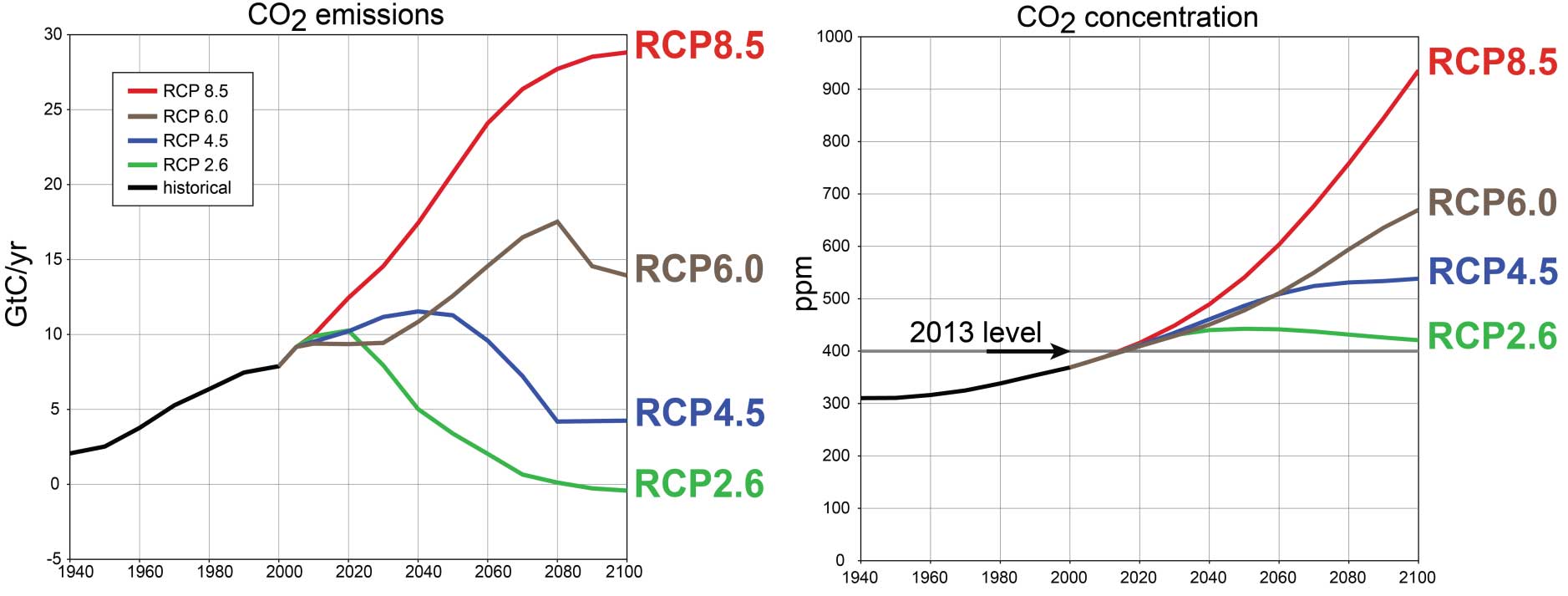
Comparisons among 4 IPCC scenarios of Greenhouse Gas emissions
Image Source
Adapted from Figure TS.19 in the Intergovernmental Panel on Climate Change (IPCC) (2013) Climate change 2013: the physical science basis. Contribution of working group I to the fifth assessment report of the intergovernmental panel on climate change. Cambridge University Press, Cambridge, UK.
